Access is not use: how we get employees to actually learn
When we launched the Keep Growing Academy, I talked to many business owners about the idea of an online learning platform. For some it was completely new. Others had already tried one.
That second group kept telling me a similar story. The offer was interesting, there were strong courses on it. And yet it was hardly used. After a year, what remained was mostly the invoice, and little enthusiasm to invest in it again.
That story helped shape our Academy. Not the question of which courses we offer, but the question of how we make sure people actually follow and apply them.
Why access is not enough
If you give employees access to dozens of courses at once, what you mainly give them is a choice. And a big choice without a starting point rarely leads to a start.
That is not down to a lack of motivation. Most employees do want to learn. But on a busy working day, what is urgent always wins from what is important. Without a clear first step and without a moment that reminds them, learning stays a good intention.
And even someone who completes a course does not change the way they work just by doing so. Knowledge only becomes valuable when it is used on the job. That is where the real return on a learning investment lies.
An activation programme, included as standard
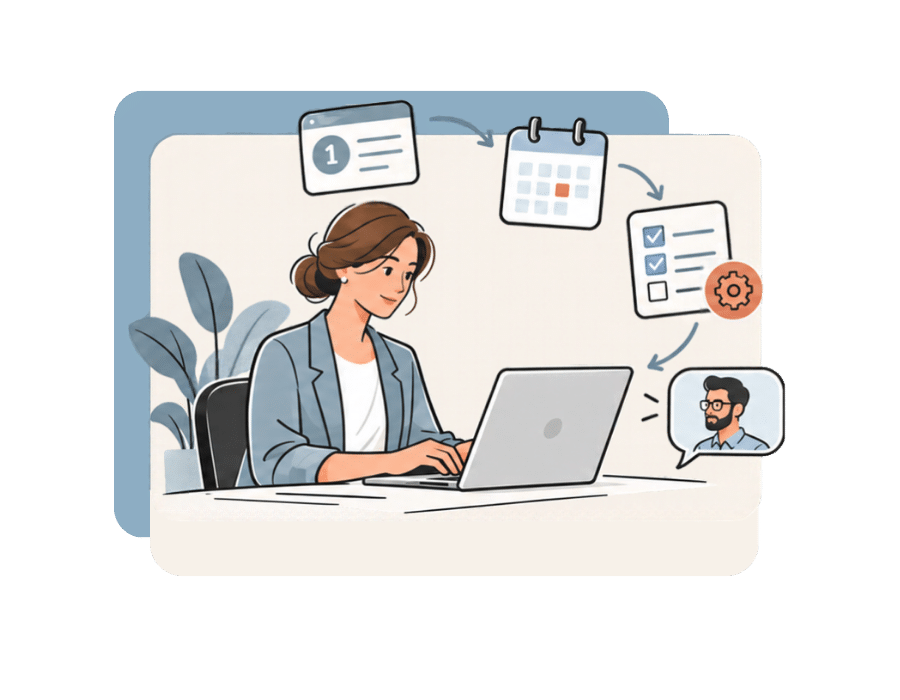
That is why, with the Keep Growing Academy, we don’t just bring courses to companies, but a complete activation programme. You don’t need to do anything extra for it. You activate your licences in a few clicks, and from then on our activation flow starts for every employee.
That flow is not a series of loose reminder emails. It is built entirely around four learning principles, each based on research into behaviour change and learning transfer.
The four learning principles behind our activation flow
1. A small first step and a clear prompt

According to BJ Fogg’s behaviour model, behaviour happens when three things come together: motivation, the ability to do something, and a prompt that sets it in motion at the right moment. If one is missing, nothing happens.
That is why every employee starts with a course of a few minutes that delivers something straight away. And that is why every email points to exactly one course, never to the full overview. The smaller the step, the more likely someone is to take it.
2. A fixed rhythm
Learning everything in one go works less well than learning in small portions, spread over time. That is one of the best-supported insights from learning research.
That is why our flow sets one new step every two weeks. That way, learning becomes a habit instead of an intention, and what you learn gets time to sink in.
3. Applying over completing
Peter Gollwitzer showed that people carry out an intention far more often when they decide in advance exactly when and where they will do it. He calls these implementation intentions.
That is why, after every course, the employee gets one concrete assignment for the workplace, and the question of where they will apply it this week. The goal is not completing the course, but what someone does differently afterwards.
4. The manager as a lever
Robert Brinkerhoff researched why training does or does not lead to results. His conclusion: whether something sticks depends more on the work environment than on the training itself. The manager plays the biggest role in that.
That is why we involve the manager in the programme, with a limited and feasible effort. A short kick-off in the team meeting, an occasional question about what the team has applied, and an update on how the team is progressing. Together, that is a few minutes a month.

What we measure
Hours of learning time say little about what a training delivers. We look at four things, in this order:
- Started: does an employee begin their first step within the first two weeks?
- Completed: do they keep up with the rhythm of the programme?
- Applied: do they use what they learned on the job?
- Seen: does their manager notice a difference in how they work?
The first two show whether the programme works. The last two show whether the investment pays off.
To be continued
A learning platform is only a good investment when it is used, and when that use becomes visible in how people work. That is what our activation flow was built for.
The first companies are going through the programme now. Within six months, we will share here what it has delivered: how many employees started, what they applied, and what their managers saw change.
Curious how this would work for your team? Get in touch.
Share on:


